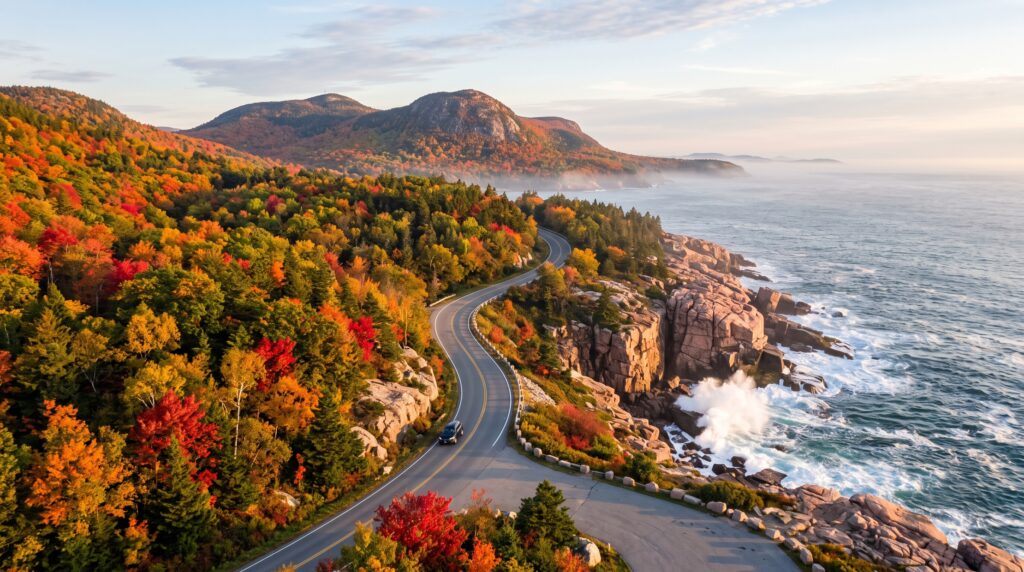
Autumn transforms Downeast Maine into a vivid tapestry of crimson red, burnt orange, and brilliant gold. One of the best ways to experience this is by taking the Acadia All-American Road scenic drive.
Along the coast, craggy pink granite cliffs meet the deep navy waters of the Atlantic Ocean.
The Acadia Byway stretches across 40 unforgettable miles of maritime beauty and mountain wilderness.
Consequently, travelers from around the globe consider this drive one of America’s finest road trips.
First designated as an All-American Road in 2002/2009, the route continues to captivate visitors every season.
Crisp autumn air carries the refreshing scent of balsam fir and ocean brine.
Whether you plan to hike rugged summits or admire harborside cottages, this corridor offers pure New England wonder.
Scenic Byway Overview and Fast Facts
The Acadia Byway delivers an immersive sensory journey through historic Mount Desert Island.
Glacial valleys cradle crystal-clear ponds that mirror blazing red maple canopies.
Fishing boats bob gently in Frenchman Bay while bald eagles circle high overhead.
Indeed, the route offers unmatched access to outdoor recreation, coastal heritage, and world-class dining.
-
Designation Info: All-American Road (2002/2009)
-
Intrinsic Qualities: Scenic, Recreation
-
Geographic Location: Trenton and Mount Desert Island, Maine
-
Total Length: 40 miles
-
Primary Route: Maine State Route 3 to Park Loop Road
[Trenton Mainland Entry]
       │
       ▼ (Route 3 South)
[Thompson Island Visitor Area]
       │
       ▼ (Route 3 South)
[Downtown Bar Harbor]
       │
       ▼ (Park Loop Road Entrance)
[Acadia National Park Circuit]
  ├── Cadillac Mountain Summit
  ├── Thunder Hole Coastal Chasm
  ├── Otter Cliff & Ocean Path
  └── Jordan Pond House & Carriage Roads
Essential Byway Visitor Information
Before you hit the road, consult these verified contacts for current seasonal operations.
-
Acadia National Park Headquarters: Call 207-288-3338 for updated trail closures, weather alerts, and ranger programs.
-
Maine Department of Transportation: Call 207-624-3300 for real-time traffic updates, regional road work, and coastal driving conditions.
-
Visit Maine State Tourism: Call 888-624-6345 for statewide autumn foliage trackers, lodging guides, and travel planning tools.
The Rich Story of Mount Desert Island
Long before European contact, Native cultures inhabited this fertile, coastal island for thousands of years.
In 1604, French explorer Samuel Champlain sailed into Frenchman Bay and named the land L’Isles des Monts Deserts.
Subsequently, British and French forces fought for nearly 100 years for sovereignty over the region.
During the first half of the 20th century, wealthy American families recognized the island’s rare natural beauty.
Prominent figures built grand shingle-style cottages across the hillsides of Bar Harbor.
Philanthropist John D. Rockefeller, Jr. financed and engineered a sprawling 45-mile network of broken-stone carriage roads.
Today, a sturdy mainland bridge connects Mount Desert Island and Acadia National Park to the rest of Maine.
As a result, this breathtaking region welcomes millions of travelers who come to hike, bike, and explore.
Outdoor enthusiasts can tackle 26 distinctive mountain peaks or pedal along miles of peaceful carriage paths.
Furthermore, 22 sparkling lakes and ponds offer tranquil autumn retreats for paddling, fishing, and photography.
Mile-by-Mile Itinerary: From Trenton to Park Loop Road
Follow this organized route to experience the best coastal stops along the byway.
Step 1: Discover Trenton and Thompson Island
Your coastal adventure begins on the mainland in the seaside town of Trenton with the historic Trenton Grange.
-
If your journey falls on the third Saturday of the month, drop by for Trenton’s beloved Contra Dance.
-
Volunteers provide food and drinks, welcoming families with no prior dance experience required.
-
Live fiddle music fills the historic hall with vibrant, authentic community warmth.
Next, drive south along Route 3 across the bridge toward Thompson Island. Note that while the former staffed visitor facility on the island is permanently closed, the scenic outdoor grounds and picnic areas remain accessible.
-
The island honors a Revolutionary War colonel who acquired the land in the late 1700s.
-
Outdoor interpretive panels highlight local salt marsh ecology and regional natural history.
-
The Thompson Island Picnic Area sits under golden birch trees overlooking Mount Desert Narrows toward mainland Trenton.
-
From the shoreline, you can also view Thomas Island, the largest of the three-island archipelago.
Step 2: Experience Bar Harbor
After crossing onto Mount Desert Island, Route 3 leads directly into bustling downtown Bar Harbor, where you can stop by the Bar Harbor Chamber of Commerce Visitor Center.
-
The downtown area seamlessly combines historic maritime traditions with vibrant arts, shopping, and dining.
-
Stroll along tree-lined streets bordered by local art galleries, artisan craft shops, and cozy cafes.
-
Indulge in fresh seafood caught, delivered, and cooked straight from the boat, including warm buttered lobster rolls.
-
Water excursions include guided sea kayak tours, paddleboards, and historic windjammers to view harbor seals and bald eagles.
Step 3: Enter Acadia National Park
Acadia National Park consistently ranks among the top ten most visited national parks across the United States.
The park welcomes more than three million visitors each year from every corner of the earth.
You can drive your personal vehicle or take an authentic horse-drawn carriage ride through the forest.
Rockefeller’s well-marked roads wander through fragrant spruce-fir woodlands and circle tranquil freshwater ponds.
Every mountain bend reveals stunning panoramic views of the Atlantic Ocean and outlying granite islands.
Trails range from peaceful lake paths to sheer granite precipices fitted with iron rung ladders.
Featured Byway Points of Interest
Make sure to include these iconic stops along the Park Loop Road circuit.
| Point of Interest | Location & Milepost | Notable Highlights | Contact / Pass Requirements |
| Cadillac Mountain | Summit Road off Park Loop Rd | First place sun rises on US soil (seasonally); highest Atlantic coastal summit | Timed vehicle reservation required during operating season via Recreation.gov |
| Jordan Pond House Restaurant | Southwestern end of Park Loop Rd | Historic dining room, golden popovers, strawberry jam, tea lawn | Phone: 207-276-3316; advance reservations recommended |
| Thunder Hole | One-way section, Park Loop Rd | Roaring sea chasm, crashing ocean swells, 40-foot water plumes | Included with standard park entrance pass |
| Otter Cliff | South of Thunder Hole, Park Loop Rd | 110-foot pink granite precipice, panoramic Atlantic views | Included with standard park entrance pass |
| Eagle Lake | Route 233 / Carriage Road access | Clear freshwater lake, gravel carriage trails, autumn reflections | Included with standard park entrance pass |
Cadillac Mountain
Rising 1,530 feet above the Atlantic, Cadillac Mountain stands as the highest point along the eastern seaboard of North America.
-
During key months, this pink granite summit is the first place to see the sunrise on US soil.
-
You can drive the winding summit road or hike up via scenic woodland trails.
-
In autumn, looking down across Frenchman Bay provides an astonishing view of vibrant foliage bordering azure waters.
Thunder Hole
Carved through centuries of relentless wave action, Thunder Hole demonstrates the incredible power of the ocean.
-
When high swells roll in, air and water compress inside a deep cavern beneath the viewing deck.
-
A loud thunderous roar reverberates through the stone as waves crash inward.
-
Plumes of white sea spray launch up to 40 feet in the air, drenching onlookers along the walkway.
Jordan Pond House Restaurant
Historic tradition continues at Jordan Pond House Restaurant, the celebrated dining destination operating inside Acadia National Park.
-
Since the late 1800s, guests have gathered on the lawn for warm baked popovers and sweet strawberry jam.
-
Sip afternoon tea while looking across clear blue water toward the iconic North and South Bubble mountains.
-
Following your meal, walk the loop trail around the shoreline to immerse yourself in golden autumn birch groves.
Otter Cliff
Rising 110 feet straight out of the crashing Atlantic surf, Otter Cliff offers one of the most dramatic coastal views in North America.
-
The sheer pink-granite wall catches glorious warm sidelight during the late afternoon golden hour.
-
Accessible via the Ocean Path, it presents safe viewing ledges overlooking pounding Atlantic swells.
-
Spruce trees clinging to the cliff edge frame dramatic ocean and headland horizons.
Eagle Lake
Nestled beneath the northern ridges of the park, Eagle Lake serves as a serene recreational hub for outdoor lovers.
-
A flat six-mile loop trail connects seamlessly to the historic broken-stone carriage road network.
-
Calm morning waters produce postcard-worthy reflections of surrounding autumn foliage.
-
Kayakers and canoers can launch to enjoy peaceful paddling with mountain backdrops.
Autumn Photography Field Guide
Capturing fall foliage along the Acadia Byway rewards photographers with remarkable light and vivid color contrasts.
Bright crimson red maples and yellow birches frame deep ocean waters and weathered stone bridges.
Planning around low seasonal sun angles helps you capture memorable coastal compositions.
Seasonal Timing and Essential Gear
Peak foliage in Acadia typically arrives between the first and second week of October.
At this time, inland ponds mirror saturated canopies while coastal winds keep the air remarkably crisp.
-
Circular Polarizer (CPL): Cuts glare on ocean surfaces, damp granite ledges, and foliage leaves to maximize natural autumn saturation.
-
Neutral Density Filters: Bring 3-stop and 6-stop ND filters to smooth ocean waves at Thunder Hole and Otter Cliff.
-
Sturdy Tripod: Essential for long exposures and dawn breezes on exposed mountain summits.
-
Lens Recommendations: Use a 16-35mm wide-angle for expansive ocean ledges and a 70-200mm telephoto to isolate colorful mountain ridges.
Prime Photography Locations and Lighting
-
Cadillac Mountain Summit: Arrive 45 minutes before sunrise to capture pastel gradients, followed by warm dawn sidelight across Frenchman Bay.
-
Jordan Pond and The Bubbles: Shoot between 7:15 AM and 8:45 AM before surface winds develop, capturing mirror reflections of the Bubbles.
-
Otter Cliff and Ocean Path: Shoot between 3:30 PM and 5:00 PM when the low afternoon sun casts a warm golden glow across the pink granite cliffs.
-
Carriage Road Bridges and Woodlands: Overcast or misty midday conditions offer soft, even lighting that enhances forest colors around Eagle Lake.
Transit Options and Byway Driving Guidelines
Proper preparation ensures a smooth and relaxing autumn drive around Mount Desert Island.
-
Island Explorer Shuttle Service: The fare-free Island Explorer bus system provides clean, propane-powered transit across the island. The bus connects local campgrounds, village inns, and popular trailheads to reduce roadway congestion. Fall seasonal service operates through October 12, allowing riders to enjoy peak foliage without parking stress.
-
Park Pass Requirements: Every vehicle entering Acadia National Park must display a valid recreation pass through the windshield. Secure your digital pass online at Recreation.gov Acadia Passes or buy one at local visitor stations.
-
Cadillac Summit Timed Entry: Private vehicles driving up Cadillac Summit Road require an advance timed-entry reservation from May 20 through October 25. Thirty percent of reservations release 90 days in advance, while seventy percent release two days ahead at 10:00 AM ET. Book your spot through Recreation.gov Cadillac Summit Reservations.
-
Shoreline Safety: Autumn storms bring strong ocean surf. Coastal rocks become dangerously slick when wet, so remain safely behind posted barriers.
Regional Tourism Chambers and Local Partners
Connect with local chambers for up-to-date lodging recommendations, restaurant reservations, and regional event schedules:
-
Bar Harbor Chamber of Commerce: 2 Cottage St, Bar Harbor, ME | Phone: 207-288-5103
-
Ellsworth Area Chamber of Commerce: 151 High St, Ellsworth, ME | Phone: 207-667-5584
-
Southwest Harbor and Tremont Chamber: Southwest Harbor, ME | Phone: 207-244-9264
-
Trenton Chamber of Commerce: Trenton, ME | Phone: 207-667-1259
-
Official Acadia Area Guide Download: Download current travel brochures, street maps, and lodging directories.
Sample One-Day Autumn Itinerary: The Best of the Acadia Byway
-
6:15 AM – Cadillac Mountain Sunrise: Watch morning light illuminate colorful foliage and island shores around Frenchman Bay.
-
8:00 AM – Jordan Pond Reflections: Photograph the mirror-like reflections of the Bubbles before breezes ripple the water.
-
9:30 AM – Breakfast in Downtown Bar Harbor: Sip hot coffee and enjoy warm wild blueberry pancakes at a local village cafe.
-
11:30 AM – Waves at Thunder Hole: Watch the Atlantic tide crash into the granite inlet along Park Loop Road.
-
1:00 PM – Popovers at Jordan Pond: Savor fresh golden popovers and warm tea while admiring the Bubbles across the lawn.
-
2:45 PM – Carriage Road Stroll: Walk or bike beneath golden beech and maple trees along the crushed-stone paths of Eagle Lake.
-
4:15 PM – Otter Cliff Golden Hour: Frame the dramatic pink granite precipice glowing under late-afternoon coastal sunlight.
-
6:00 PM – Sunset Lobster Feast: Finish your day with freshly steamed Maine lobster, hot chowder, and wild blueberry pie.
Frequent Questions About Driving the Acadia Byway
How long does it take to drive the Acadia Byway?
Driving the 40-mile route without stopping takes roughly two hours. However, plan a full day to hike trails, take photos, and tour Bar Harbor.
When does fall foliage peak in Acadia National Park?
Peak autumn colors typically arrive during the first two weeks of October. Vibrant foliage blankets the granite ridges and surrounding coastal forests.
Is the Island Explorer shuttle free to ride?
Yes, the Island Explorer operates fare-free courtesy of federal support, local municipalities, and park sponsors.
Can I bring my dog along the byway?
Leashed pets can join you along most scenic park roads, carriage paths, and campgrounds within Acadia National Park.
Embracing the Spirit of Coastal Maine
Driving the Acadia Byway in autumn reconnects you with the timeless rhythms of the Atlantic coast.
Few drives in North America match the dramatic harmony found along these 40 scenic miles.
Here, craggy ocean cliffs meet tranquil mountain tarns ablaze with fiery seasonal color.
Every bend in the road presents a fresh perspective on Maine’s storied seafaring past.
You can feel the heritage in hand-carved granite bridges and bustling harbor wharves.
Whether you come for sunrise above the clouds or quiet woodland walks, the memories stay vivid for years.
Therefore, secure your park passes, pack your camera gear, and embark on this unforgettable coastal journey.
Table of Contents